



Sep 2
Everyone Lives Somewhere Else Now. How Do You Arrange a Funeral When Family Is Spread Across Australia?
Posted by Acacia Funerals
My brother is in Queensland. Her grandchildren are in Melbourne. How are we supposed to organise this?
Families don’t always live around the corner anymore.
Children move.
Grandchildren study interstate.
People build lives in Sydney, Melbourne, Brisbane or overseas.
Then someone passes away in Albury, Wodonga or Lavington, and suddenly a family separated by hundreds or thousands of kilometres has to make decisions together.
Who contacts the funeral director?
Does everyone need to come home immediately?
How quickly does the funeral need to happen?
What if somebody can’t get there?
The good news is that you don’t need everyone sitting around the same table before funeral arrangements can begin.
What should happen first?
Contacting a funeral director is usually one of the first practical steps.
Acacia Funerals is based at 355 Prune Street, Lavington and cares for families across Lavington and the Albury/Wodonga region. The team can arrange transfer into its care, guide families through documentation, explain burial and cremation options and begin planning the farewell.
Acacia is available 24 hours a day, 365 days a year for families needing assistance.
That means you don’t need to solve everything before making the first call.
Does everyone in the family need to be present to make arrangements?
Not necessarily.
The important thing is establishing who will be the principal family contact and ensuring the appropriate people are involved in important decisions.
This can make things considerably easier.
Rather than five relatives separately contacting the funeral director with different instructions, one person can become the central point of communication while consulting the rest of the family.
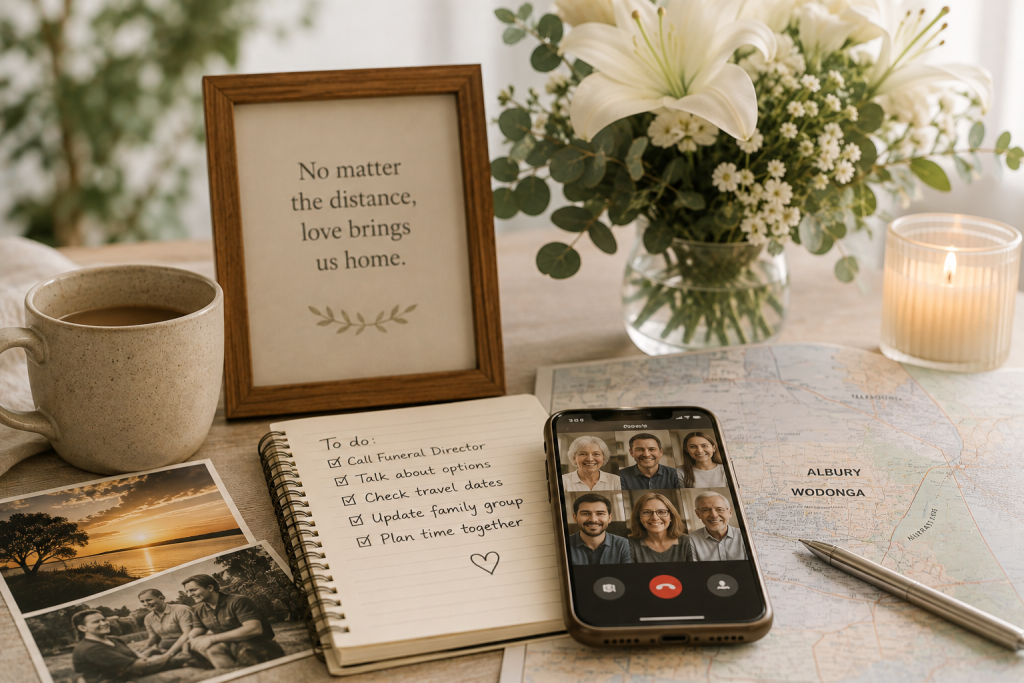
A family group chat or video call can become surprisingly useful.
Not terribly traditional.
But very practical.
What if relatives need time to travel?
Tell the funeral director.
Don’t assume the service has to happen before everyone has a chance to get there.
There are practical considerations surrounding funeral timing, but the arrangements can be discussed with the funeral director so the family understands what is possible.
Sometimes relatives can travel.
Sometimes they can’t.
And that can affect what kind of farewell feels right.
A memorial later may solve the problem
For some families, the answer isn’t trying to get everybody to Albury immediately.
Acacia Funerals offers memorial services that can take place following a private cremation or burial at a time determined by the family.
That creates another possibility.
Perhaps the immediate family chooses a private cremation.
Then several weeks later, everyone gathers for a memorial when interstate relatives can attend.
This can be particularly helpful when someone wanted a simple cremation anyway.
The practical arrangements can happen first.
The gathering can happen when the family is ready.
What if someone passes away while they’re away from home?
This creates another situation families often aren’t prepared for.
Someone from Albury may pass away while visiting Sydney.
A Wodonga resident might be interstate.
A family member could be overseas.
Acacia’s FAQ specifically notes that when a loved one passes away away from home, the team can liaise with other funeral directors to make the necessary arrangements.
You don’t have to work out how to coordinate everything yourself.
Call and ask what needs to happen next.
What if someone simply cannot attend?
This can be one of the hardest parts.
Sometimes distance isn’t the only issue.
Illness.
Pregnancy.
Work.
Travel costs.
Age.
Visa issues.
Or circumstances that simply cannot be changed.
Missing the funeral doesn’t mean somebody loved the person any less.
Consider other ways they can participate.
They might write something for another family member to read.
Send a photograph.
Choose a piece of music.
Record a message where appropriate.
Or join the family for another private remembrance later.
A funeral is one important moment.
It isn’t the only moment in which somebody can say goodbye.
Don’t let geography turn into family pressure
Grief and logistics aren’t always good roommates.
Everyone is emotional.
Everyone has an opinion.
And suddenly you’re discussing flights, funeral dates, cremation, flowers and family history in the same WhatsApp conversation.
Try to bring the decisions back to something simpler.
What did the person who passed away want, if you know?
And:
What does the family genuinely need now?
Acacia Funerals’ role is to guide families through the choices and carry out their wishes, including arranging funeral services, cremation, burial, memorial services and the associated practical requirements.
You don’t have to know how the funeral industry works.
That’s the funeral director’s job.
Home can still bring everyone back together
There is something about a funeral that can temporarily reverse the geography of a family.
People return.
Cousins see each other again.
Grandchildren hear stories they’ve never heard.
Someone finds an old photograph.
People remember who they were before everyone moved away.
For families throughout Albury, Wodonga and Lavington, arranging a funeral when everybody lives elsewhere can feel complicated.
But start with one call.
Work out what needs to happen first.
Then deal with the next decision.
And the next.
You don’t have to organise the entire goodbye in a single afternoon.
Frequently Asked Questions
Which areas does Acacia Funerals serve?
Acacia Funerals serves families across Lavington and the wider Albury/Wodonga region and can coordinate arrangements further afield when required.
Where is Acacia Funerals located?
Acacia Funerals is located at 355 Prune Street, Lavington NSW 2641.
Is Acacia Funerals available after hours?
Yes. Acacia states that it is available 24 hours a day, 365 days a year.
What if our loved one passes away interstate?
Acacia advises that it can liaise with other funeral directors when someone passes away away from home to help make the necessary arrangements.
Can we arrange a memorial later?
Yes. A memorial service can take place following a private burial or cremation at a time determined by the family.
Does Acacia Funerals offer direct cremation?
Yes. Acacia specialises in direct cremation and describes it as a simple no-service, no-attendance option.
Can Acacia help with funeral paperwork?
Yes. Its services include liaising with medical professionals, arranging necessary documentation and registering the passing with Births, Deaths and Marriages.
Who should contact the funeral director when several family members are involved?
Families can nominate an appropriate primary contact to communicate with the funeral director and keep other relatives involved in important decisions.
Everyone Lives Somewhere Else Now. How Do You Arrange a Funeral When Family Is Spread Across Australia?
My brother is in Queensland. Her grandchildren are in Melbourne. How are we supposed to organise thi
Acacia Funerals
Sep 2, 2026

Can We Bring Something That Belonged to Them? The Little Things That Can Make a Farewell Feel Personal
“Would it be strange if we brought his old hat?” No. Bring the hat. Bring Mum's recipe book.
Acacia Funerals
Aug 2, 2026

They Didn’t Want a Funeral.” Does That Mean We Can’t Have a Memorial Later?
“They always said they didn't want a funeral.” It's something many families remember after some
Acacia Funerals
Jul 2, 2026

Breaking the Silence: How to Talk to Your Family About Funeral Pre-Planning
Talking about funeral pre-planning is a conversation that many people avoid, yet it is one of the mo
Acacia Funerals
Jun 10, 2026